


11 Best Different Types of Checkers: From American Classics to International Variants

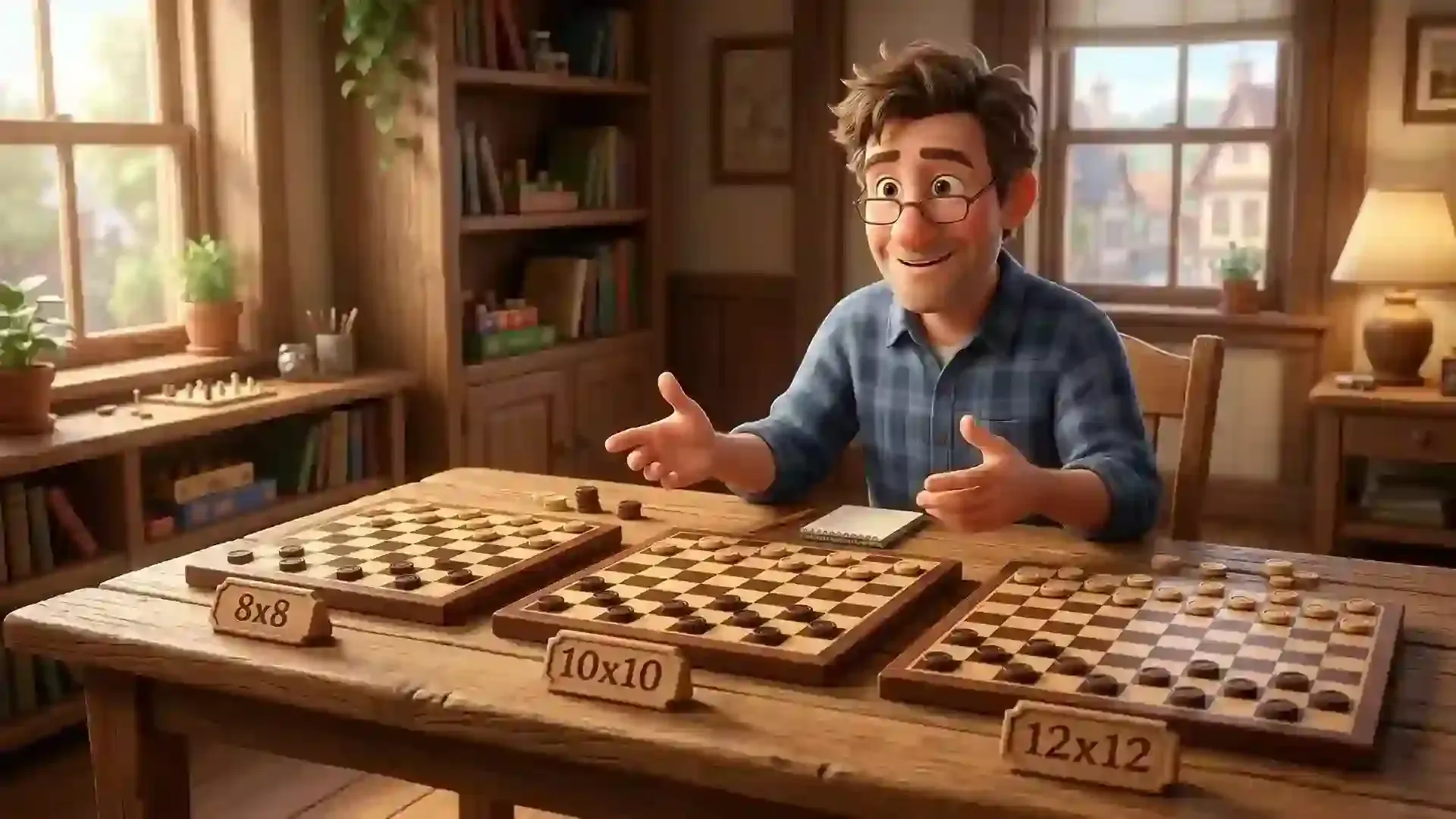
The majority of individuals believe that there is only one set of rules for checkers. As a matter of fact, it is a huge family of dozens of various games played on every continent.
Checkers has a history dating back to the 12th century in France and is based on an ancient game known as Alquerque.
There are two branches that are in control nowadays in the world, the Anglo-American and the Polish, or continental ones. You can play all different types of checkers online for free on many platforms.
Table of contents
The Basics: What All Checkers Games Have in Common

Although they differ in specific ways, all variations of checkers have a basic DNA(see the official rules of draughts). They are played on a checkered board where the players move the pieces in a diagonal manner in order to capture the marks of the opponent by jumping over them.
- The Board: Typically 8x8, 10x10, or 12x12.
- The Goal: Usually, to capture all opposing checkers or block them so they cannot move.
- The Movement: Most versions require jumping when a capture is available.
- The "King": Reaching the far side usually promotes a piece, granting it new powers.
Whether you call it "Checkers" or "Draughts," the spirit of the hunt remains the same. In Italian and Spanish Checkers, “Men” refers to the regular pieces. In fact, the checkers vs draughts debate often comes down to geography, the same 8x8 game simply carries a different name depending on where you live.
Strategy in checkers often draws comparisons with other classic board games, especially when evaluating decision-making, board control, and long-term planning. These differences become clearer when looking at checkers vs chess in terms of structure and gameplay approach.
Types of Checkers And Key Differences
| Type | Board | Pieces Each | Movement | Key Difference |
|---|---|---|---|---|
| American | 8x8 | 12 | Diagonal | Standard rules: pieces move forward only. |
| Suicide | 8x8 | 12 | Diagonal | The goal is to lose all pieces first. |
| Italian | 8x8 | 12 | Diagonal | Men cannot jump Kings; strict capture rules. |
| Spanish | 8x8 | 12 | Diagonal | Features "Flying Kings" on an 8x8 board. |
| International Draughts | 10x10 | 20 | Diagonal | 10x10 board; maximal capture is required. |
| Canadian | 12x12 | 30 | Diagonal | Massive 144-square board; long games. |
| Turkish | 8x8 | 16 | Orthogonal | Moves forward and sideways, never diagonal. |
| Russian Checkers | 8x8 | 12 | Diagonal | Instant King promotion during jump sequences. |
| Hexadame | Hex | 12 | Hex-based | Played on a hexagonal grid. |
| Chinese | Star | 10 | Hop-based | A race to the opposite side; no captures. |
Standard and American Checkers Variations

The most familiar of these variations in the Western world is played on the traditional 64-square board. Each variation also differs in starting piece count, and understanding how many pieces in checkers are used per version helps players switch between formats without confusion.
1. American Checkers (British Draughts)
This is the classic version familiar to most. It is played on a 12-piece board of 8x8. The pieces move on squares diagonally, and jumping is mandatory. For those looking to gain an early advantage, studying the best checkers opening is key, as controlling the center prevents your opponent from flanking you.
2. Suicide Checkers (Anti-Checkers)
The goal is reversed in this type of losing draughts. Winning is playing to have no legal moves, which usually means losing all your pieces to your opponent. Since jumping is required, you can compel your opponent to accept your pieces; therefore, it is a surprisingly deep strategy game that rewards counter-intuitive reasoning.
3. Corner Checkers
The only significant difference here is the setup. Players now place their pieces in opposite corners of the board, not the first three rows. This unique checkers board setup quickly opens the middle of the board, so battles and tactics begin right away.
4. Italian Checkers
The game is played on an 8x8 board, only with a twist: Men may not jump Kings. This gives the King piece a significant power advantage. More so, when you have several choices of a jump, then you must follow the path that carries the most pieces. In case those numbers are equal, then you must take the pieces of the higher rank (Kings over Men).
5. Spanish Checkers
Like the Italian one, with the addition of the Flying King. When a piece has been crowned, it can travel any distance along an unoccupied diagonal, as a Bishop does in chess. This significantly increases endgame speed and deadliness because one King can take up large portions of the board. Mastering the long-range move also makes it easier to learn how to double jump in checkers across the entire board in a single turn.
International and Regional Checkers Variations

As we move across borders, the boards get larger and the rules get more complex. These variants often emphasize "maximal" play and long-range movement. A well-built online checkers website will typically offer several of these regional formats alongside the standard American version.
6. International Draughts (Polish Draughts)
- Flying Kings: Kings can move any distance in a diagonal fashion.
- Maximum Capture Rule: When you have two choices of jumping, you need to select that which leaves the greatest number of pieces.
- Backward Jumping: Non-King pieces are also allowed to jump backwards and capture.
This significantly increases endgame speed and deadliness because one King can take up large portions of the board. To master these long-range moves, you can explore flying king strategies in checkers.
7. Canadian Checkers
The 10x10 board is considered too small by some of the thinkers; Canada provides a 12x12 grid with 30 pieces on each side. The rules are based on the International format; however, the number of pieces is so large that the games are significantly longer and more demanding to your memory and vision. The sheer scale of Canadian Checkers reflects how differently various cultures interpreted the same foundational game, a recurring theme throughout the history of board games as communities adapted rules to suit their own tastes.
8. Turkish Checkers (Dama)
The Dama in Turkey is an interesting outlier. Pieces travel in an orthogonal fashion (forward and lateral) as opposed to a diagonal movement. It provides a window into the broader history of checkers by showing how the game branched off into non-diagonal movements in different cultures.
The second and third rows each contain 16 pieces. It is more like a military scuffle than a normal checkers game because the pieces move like Rooks in Chess, but a square at a time.
9. Russian Checkers
In the Russian version, a piece that lands on the back row on a jump sequence turns into a King instantly and has the ability to keep jumping in the same turn as a King. This results in high-capture, explosive turns that can expel half of an opponent's army in one move. A similar hunger for aggressive King play appears in Brazilian Checkers, where crowned pieces glide freely across the diagonals, rewarding players who can play Brazilian Checkers online with a sharp eye for open lanes.
10. Hexadame
This is a contemporary version that is played on a hex board. Because the cells are hexagons, pieces can move in any direction. Learning the spatial geometry of this version is essential if you want to know how to win at checkers on a non-traditional grid.
Chinese Checkers Variations

Chinese Checkers is not a game of checkers, as the name may suggest. It is German in nature, called Sternhalma, and does not consist of leaping over pieces. Instead, it is a race.
- Standard Chinese Checkers: The players move marbles in the form of 10 on a star-shaped board. You may jump over your marbles or your opponent to the other triangle of the field, which is the home.
- Super Chinese Checkers: Also known as "Fast" Chinese Checkers. You can jump over a marble in this version even when it is not in the same hole, although there is the same distance on the other side.
- Team Chinese Checkers: It is typically played with 6 players, with the opposing players being partners and they can help each other with the movement of their marbles to the home zones.
- Capture Chinese Checkers: This kind is not common, where you actually steal away the marbles you are jumping over. The winner is the one who has the most marbles at the end, and this introduces the game into the capture of traditional checkers.
- Diamond Game: The game is a variation of the game on a smaller board in the shape of a star, but in this case a diamond, and is usually played by two or three players. The board shape, number of players, and marble movement make the Chinese checkers rules unlike anything else in the checkers family.
Which Type of Checkers Should You Play?
- For Beginners: Stick with American Checkers. It is the most accessible way to learn the fundamentals of spacing and King management.
- For Competitive Minds: International Draughts is the gold standard. The 10x10 board reduces the frequency of draws and rewards deep calculation. It is also the format where the top draughts players in the world have built their legendary careers.
- For a Change of Pace: Try Turkish Dama. The orthogonal movement feels completely fresh if you are used to diagonal play.
- For Social Gatherings: Chinese Checkers or Suicide Checkers are excellent choices for a game night, offering high interaction and quick turns.
FAQs
- Dozens of them exist, although the most widespread ones include American, International (Polish), Turkish, Russian, and Italian checkers.
- No. Regular Checkers is a capture-and-elimination game, whereas Chinese Checkers is a racing game played on a star-shaped board.
- In the world, the most popular type of International Draughts on a 10-by-10 board is most commonly used in competitions, although American Checkers is popular in the US and UK.
- The easiest one to begin with is American Checkers since it has fewer boards and rules. It is also among the oldest forms of checkers.
- It uses a 10-by-10 board, each player has 20 pieces, there is a rule called the "Flying King," and you always have to make the biggest possible capture.

Physical Board vs. Digital Checkers: Does the Classic Feel Get Lost Online?

US vs UK: Which Country Really Loves Checkers? (Checkers vs Draughts, Explained)

Enjoy Free Multiplayer Checkers with Friends Online
What Checkers Teaches You: Skills Beyond the Board
The Psychology of Checkers: Why This Simple Game Plays Mind Games