



Best First Move in Checkers: Winning Opening Tips

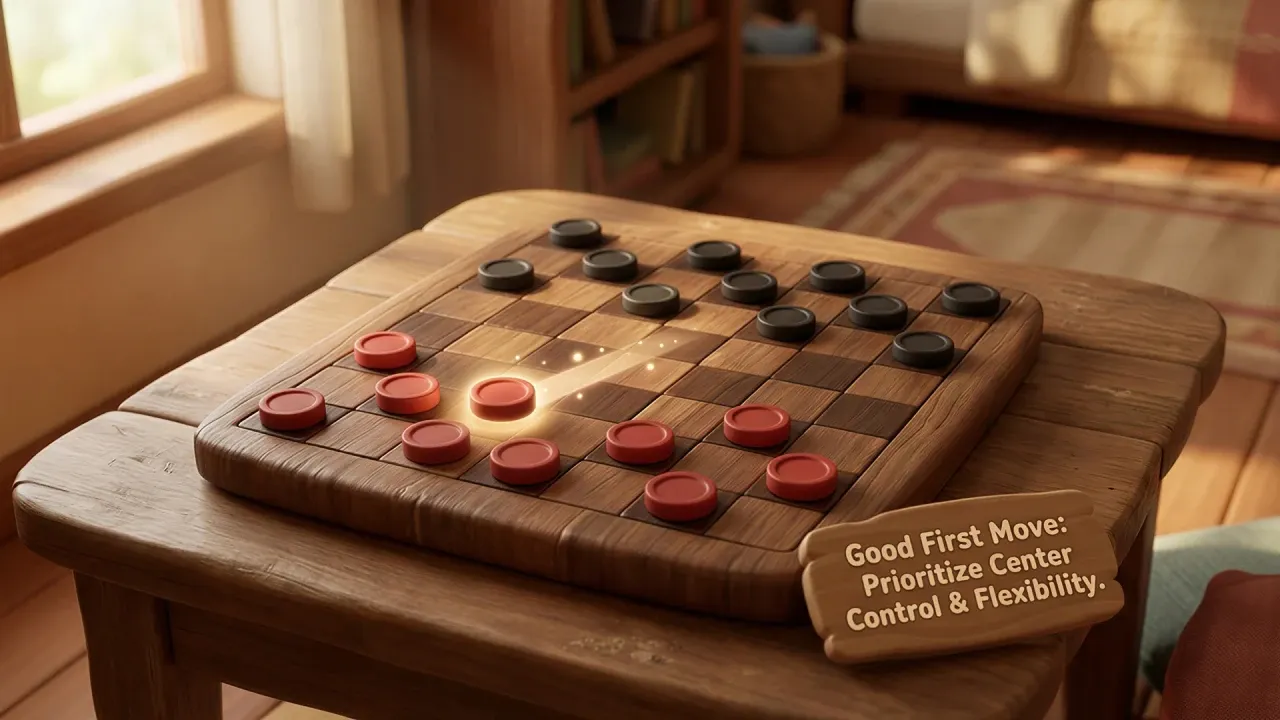
The first move in checkers has been one of the key play which is why you have to choose the best first move in checkers, which can help you to win the game.
This comprehensive guide examines premier openings, including Old Faithful, best checkers openings, and proven sequences to dominate the board, which you can try playing checkers online.
Table of contents
- What Is the Best First Move in Checkers?
- Why the First Move Matters in Checkers
- Old Faithful Checkers Opening Explained
- Other Best Opening Moves in Checkers
- Best Opening Moves in Checkers for Beginners
- Best Moves in Checkers After the First Turn
- Common Opening Mistakes to Avoid
- Best Checkers Opening Strategy Principles
- Conclusion: Start Strong With the Right Opening
What Is the Best First Move in Checkers?
The first step in checkers is 11-15, also known as Old Faithful. This moves the piece to squares 11 to15, and this wins the central dominance.
It is superior because of its dominance over strategic squares, its restriction of the opponent's mobility, and its ability to facilitate future actions. This has been proven by analyzing large game databases, where Red has a win rate of 55-60%.
Why the First Move Matters in Checkers
The preliminary stage establishes the strategic base of any match. An initial position gives away positional advantage to the competitor. If you want to know how to win checkers every time, then you should start with the best opening move.
These include major principles such as central occupation, coordination of pieces, and prevention of initial vulnerabilities. Elite first moves in checkers, such as 11-15, facilitate transitions to superior moves, culminating in advantageous king promotions.
Old Faithful Checkers Opening Explained
Old Faithful checkers stands as the benchmark among the best opening checkers moves, offering consistency and potency.
What Is Old Faithful (11–15)
On the standard 8x8 English draughts board understand the full checkers board setup squares are numbered 1-32 from Black's perspective.
It exerts influence over squares 14-18 and the adjacent zones, compelling Black to make constrained responses. Its versatility supports both offensive and defensive continuations, making it the preeminent best move in checkers.
Other Best Opening Moves in Checkers
Consider these ranked alternatives among the best opening moves in checkers.
10–14 Opening Move
Advances 10 to 14 for prompt central engagement.
Advantages: Expedited development and jump preparations.
Risks: Vulnerability to Black's 18-23 reply. Suitable for equilibrated contests.
9–13 Opening Move
A forward 9-13 thrust emphasizes aggression.
Advantages: Immediate threats and accelerated king paths.
Risks: Exposure to tactical forks. Recommended for the best moves for checkers in superior positions.
12–16 Opening Move
12-16 establishes a robust defensive array.
Advantages: Enhanced resilience.
Risks: Delayed central penetration. Effective against imprudent adversaries, who may find themselves trapped in a checkers stalemate.
Each variant aligns with specific strategic objectives: comprehensive control (11-15), equilibrium (10-14), initiative (9-13), and fortification (12-16).
Best Opening Moves in Checkers for Beginners
Novice players should prioritize 11-15 as the best first-checkers move: straightforward, secure, and progression-oriented. If you are completely new, first its important to understand how to play checkers before diving into openings.
Succeed it with 10-14, eschewing peripheral advances that invite entrapment. Develop coordinated units toward the promotion row.
Best Moves in Checkers After the First Turn
Sustaining opening advantages requires precise follow-through, an area often underexplored by competitors. Pair these moves with broader checkers tips and strategies to stay ahead.
How to Respond as Black
Counter Red's 11-15 with 8-11 or 9-13, contesting the center before advancing 18-14. Refrain from passive 22-17.
How to Continue as Red
Proceed from 11-15 to 10-14 or 15-19, forming a dominant central triangle. Illustrative sequence: Red 11-15, Black 8-11, Red 10-14, securing territorial primacy.
Avoiding Early Tactical Blunders
Vigilantly guard against isolated pieces, favoring exchanges that accrue material or positional gains.
Common Opening Mistakes to Avoid
Playing Edge Pieces Too Early
Do not move pieces like 8 to 11 or 7 to 11 too soon. Early edge moves block your own pieces and make it hard to build a strong position.
Ignoring the Center
The center of the board is very important. If you only play on the sides, your opponent can control the middle and take over the game.
Leaving Pieces Open for Double Jumps
Avoid overextending without support to prevent multiple captures. Under the forced capture rule in checkers, described in detail by the American Checker Federation, players must take any available jump, so play patiently and protect your pieces. Always think one move ahead.
Play patiently, protect your pieces, and always think one move ahead.
Best Checkers Opening Strategy Principles
Elevate play through foundational concepts.
- Control the Center Squares: Prioritize domination of 9-14 and 18-23, the best first move in checkers fulcrum.
- Maintain Strong Formation: Foster interconnected structures; triangular arrays surpass linear deployments.
- Prepare for Midgame Exchanges: Architect openings conducive to favorable trades and king acquisitions.
Conclusion: Start Strong With the Right Opening
Elect 11-15 (Old Faithful) as the definitive best first move in checkers, leveraging unparalleled central authority. Integrate these principles, central control, formation integrity, and adaptive responses, for consistent success. Strategic foresight transforms openings into triumphs.
FAQs
- The 9-13 opening offers aggressive potential for immediate threats. However, it carries a heightened risk of tactical counters, making it preferable for experienced players.
- No single first move guarantees victory in checkers due to responsive play. However, 11-15, 10-14, and 9-13 consistently demonstrate superior efficacy across game databases.
- The first move alone cannot guarantee a win in checkers. Subsequent strategic decisions and midgame execution predominantly determine the outcome.
- The 11-15 move provides the safest first move in checkers through balanced development. It delivers equilibrated central control with minimal exposure to early counterattacks.

Physical Board vs. Digital Checkers: Does the Classic Feel Get Lost Online?
US vs UK: Which Country Really Loves Checkers? (Checkers vs Draughts, Explained)

Enjoy Free Multiplayer Checkers with Friends Online
What Checkers Teaches You: Skills Beyond the Board
The Psychology of Checkers: Why This Simple Game Plays Mind Games