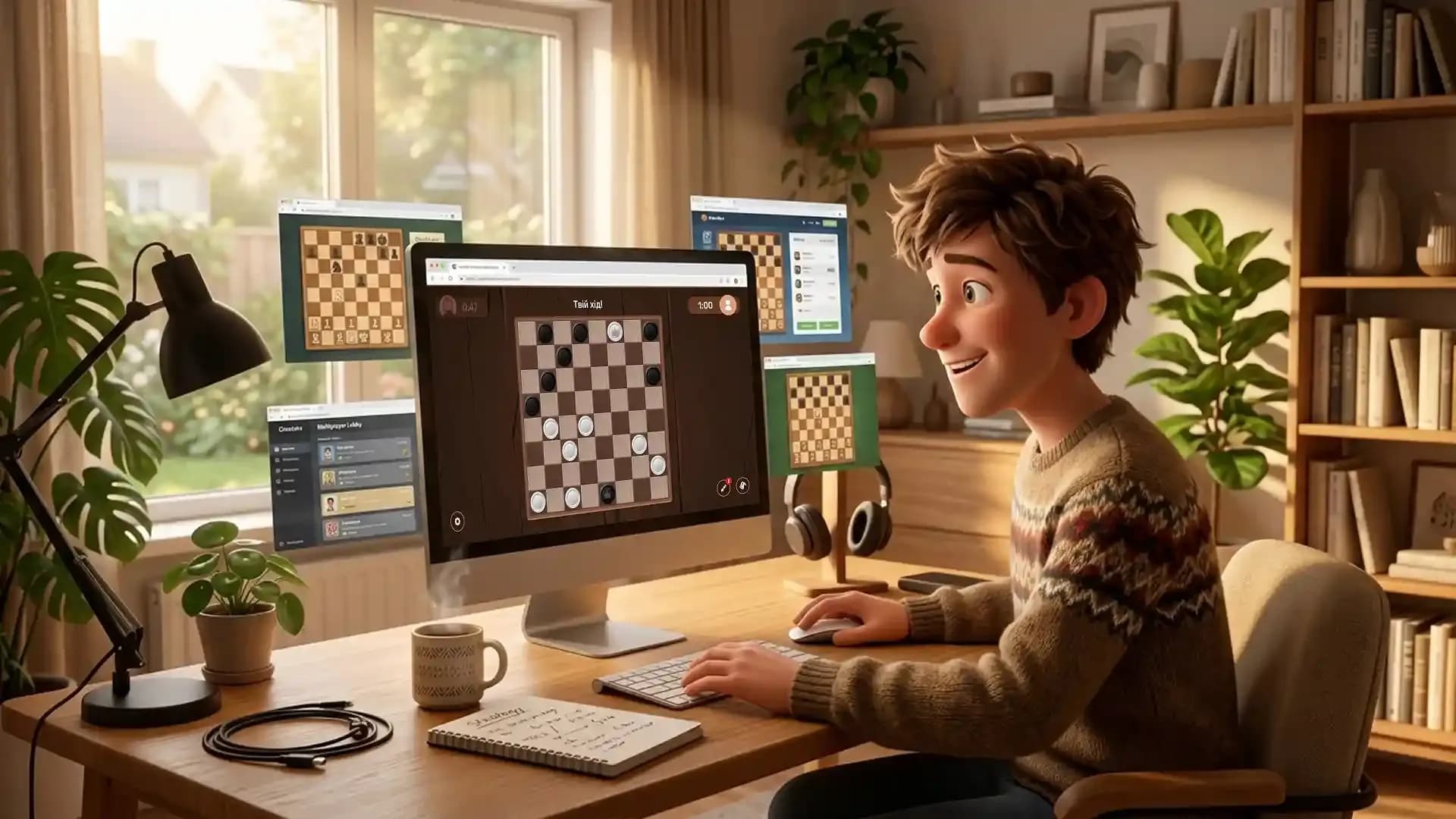



History of Board Games: Origins, Evolution & Famous Games Through Time

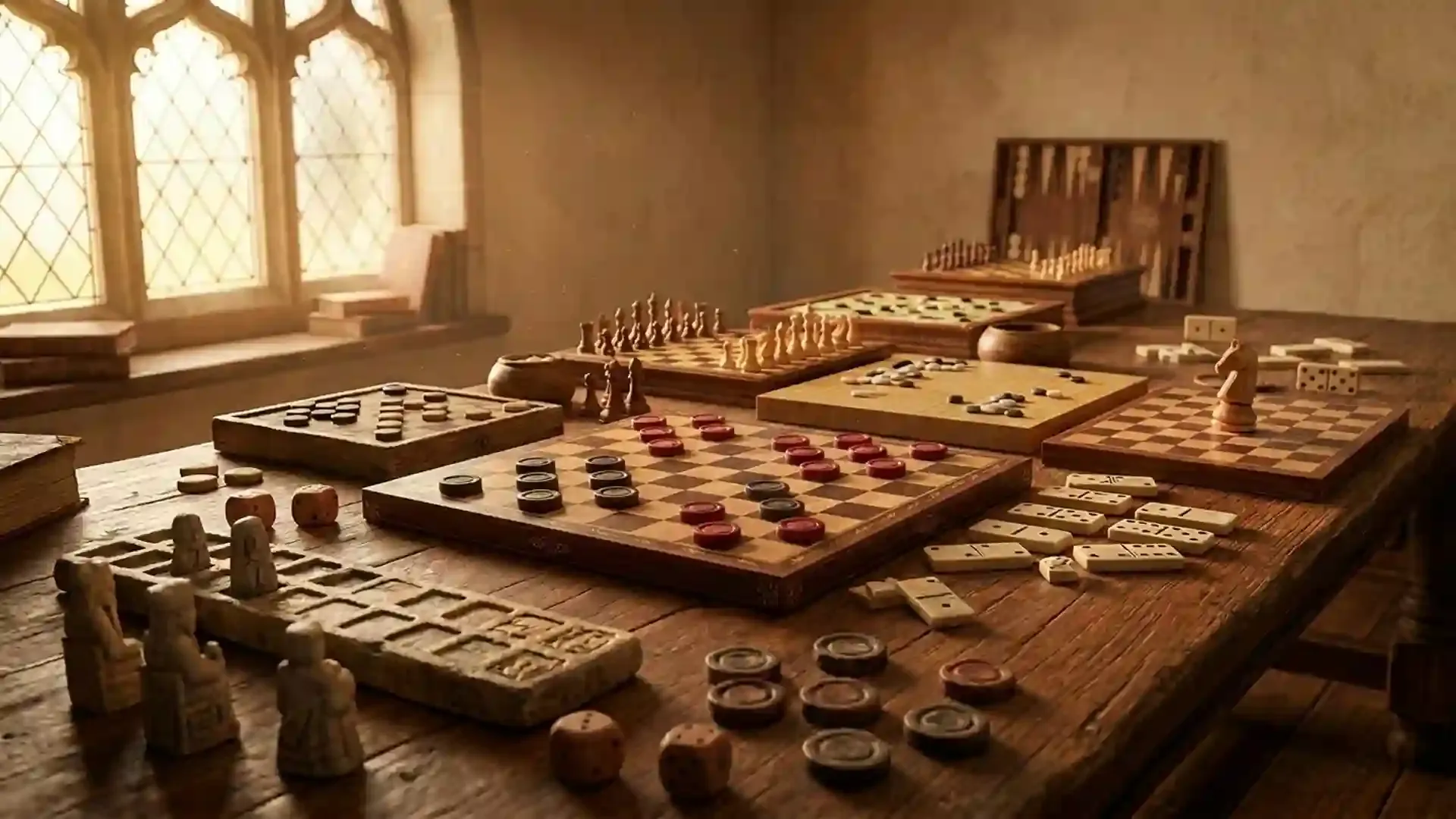
Man has been rolling dice and moving pieces on engraved stones even before he had developed any form of language, advanced mathematics, or even a simple fork.
Long before players could open a browser to play checkers online or turn on computer screens for entertainment, board games had already become an indispensable part of human culture. The history of board games can be traced back to ancient pharaonic burial chambers and even to today’s tabletop cafes.
Table of contents
What Purpose Did the First Board Games Serve?
While the contemporary concept of tabletop gaming revolves around fun, intellectual, and social stimulation, the original purpose of board games was much greater.
The first board games were tied to religion and the belief that fate controlled everything. Ancient Egyptians did not perceive the roll of the die or the cast of a divining rod as an accident; they believed the god controlled the outcome. The result of a game could be interpreted as the god bestowing favor or good luck.
Apart from religion, the games were also used as a highly effective diplomatic tool and a social lubricant along ancient trade routes, enabling cultures to interact despite language barriers. In addition, ancient tactical games were also used as training exercises for battle tactics, where actual bloodshed did not occur. Just as military minds would later dissect how to win checkers every time through perfect positioning, these early leaders used grid-based pieces to master the layout of the battlefield before the first sword was ever drawn.
History of Board Games — Complete Timeline
| Era | Milestone |
|---|---|
| 3100 BC | Senet and Mehen are played across Ancient Egypt |
| 3000 BC | Alquerque introduces the leap-and-capture mechanic in the Middle East |
| 2600 BC | The Royal Game of Ur thrives across Mesopotamia |
| 500 BC | Chess origins take root via Chaturanga in ancient India |
| 1000 AD | Chess spreads widely across European nations |
| 1100s AD | Alquerque rules are applied to a chessboard in France, creating proto-checkers |
| 1547 | The first dedicated strategy book for checkers was published in Spain |
| 1935 | Monopoly is commercialized and becomes a global phenomenon |
| 1951 | Checkers becomes the first board game to be run on a computer program |
| 1974 | Dungeons & Dragons launches, creating the RPG genre |
What Was the First Board Game? — The Earliest Known Board Games
Trying to establish the very first board game is quite impossible, given that the first boards were probably etched in sand, dirt, or a temporary piece of wood. Fortunately, we have some evidence regarding the first recognized artifacts of games.
The first actual evidence of games comes from the Fertile Crescent. Discovered in an ancient burial site (Baur Hyk) in southeast Turkey a few years ago, 49 hand-carved and painted stones suggest that board games have existed for hundreds of years before recorded history.
Piecing together this ancient board game history remains a fascinating challenge, even though some of the oldest documented systems were played in the Near East and Mediterranean, such as Senet, played by ancient Egyptians, including their Pharaohs, around 3100 BC.
Where Were the First Board Games Invented?
| Origin Region | Key Historical Games | Estimated Date of Origin |
|---|---|---|
| Middle East / Egypt | Alquerque (Ancestor of Checkers) | 3000 BC |
| Ancient Egypt | Senet, Mehen | 3100 BC |
| Mesopotamia | Royal Game of Ur | 2600 BC |
| Ancient India | Pachisi, Chaturanga (Early Chess) | 500 BC |
| Ancient China | Go (Weiqi), Liubo | 500 BC |
| Ancient Rome | Tabula, Ludus Latrunculorum | 200 BC |
Board games arose separately across numerous ancient cultures; each type varying in its particular rules based on the beliefs of its origin.
Ancient Mesopotamia & Egypt — Alquerque
Alquerque (or Quirkat) was invented around 3000 B.C.E. In the Middle East and ancient Egypt. In Alquerque, the game is played on a board consisting of intertwined lines drawn on a 5-by-5 grid, in which the pieces "jump" and take one another. This foundational capturing mechanic directly paved the way for the famous double jump in checkers that modern players use to sweep multiple opposing pieces off the board in a single turn.
Ancient Egypt — Senet, Mehen
Both board games played by the Egyptians were popular not only among the nobles but also among the working people of the era. "Passing" (or Senet in Egyptian) was an ancient racing board game played on a 30-square board. However, it also carried a great spiritual meaning. Instead of simply competing against opponents, the board depicted the soul's path on its journey to the afterlife.
Another game played by the Egyptians was called Mehen. It consisted of moving lion-shaped pieces along a snake-like board and is thought to have been called Mehen (meaning 'snake') because it represents a snake god guarding Ra on his sun-boat.
Mesopotamia — Royal Game of Ur
Invented around 2600 B.C. In Iraq, the Royal Game of Ur (or Twenty Squares) is a race game that is played using four-sided, pyramid-shaped dice. A board track runs down the center, and through traders communicating across the vast trading networks established at the time, the board game spread throughout the Middle East and eventually reached places as far as Cyprus and India.
Ancient India and China — Pachisi, Go, Liubo
Strategy and philosophy were among the main components used in the development of early board games in ancient India. In around 500 BC, there emerged Pachisi, which is the precursor of Ludo and Parcheesi, using cowrie shells for dice. Chaturanga, a four-player military strategy game, originated in this period and spread through the Silk Route to other regions, eventually evolving into the modern rules of chess we know today.
In ancient China, much attention was paid to abstract strategy games. Go (Weiqi) was developed around 500 BC. Philosophy and military leaders found Go valuable for its focus on territorial control and encircling the enemy's pieces. Other games were prevalent in ancient China, particularly Liubo, a very popular game in the Han Dynasty, which involved throwing dice sticks.
Board Games Through the Ages — A Historical Journey
As empires expanded and collapsed, board game history moved along with them, shifting alongside changing social structures.
Classical Civilizations — Greece and Rome
Games that had been played in temples in Greece and Rome soon found their way to barracks and the Forum. The Roman game called Tabula was a race game played with three dice. It led directly to the game we know today, backgammon. Two more common tactical war games of ancient Rome include Ludus Latrunculorum (the game of brigands) and Petteia, games played on a grid.
The Middle Ages — Chess and Backgammon Rise
Around the 12th century, players in France made a brilliant cross-cultural adaptation: they took the rules of Alquerque and transposed them onto a standard 8 x 8 chessboard. Originally called Fierges or Ferses (named after the chess Queen, which at the time could only move one square diagonally), this hybrid game combined the spatial awareness of chess with the fast-paced jumping mechanics of Alquerque.
The Renaissance and Early Modern Period
These evolved into the games that are more known now and into Dames (France) and Draughts (Britain) by the 15th and 16th centuries. During this period, the single biggest innovation was to include the rule of "forced capture" into the game. The first book on the strategy of the game was published in Valencia, Spain, in 1547.
How Have Board Games Changed Over Time?
Checkers was at the absolute forefront of the mass-production boom and the early digital revolution.
The 19th Century — Mass Production Changes Everything
As mass production took over the 19th century, draughts/checkers became the definitive household game due to its simple components. It required only a two-color grid and simple wooden discs. This accessibility led to the first official World Checkers Championship in the 1840s, long before many other modern sports or games had unified international rules. This mainstream visibility also planted the seeds for checkers in pop culture, as the game's presence in every household made it a natural symbol for artists, writers, and filmmakers throughout the following century.
The 1930s — Monopoly and the Great Depression Era
In the 1930's, the world fell into a recession and depression; however, home entertainment, as it turned out, was highly successful during these times of financial hardship, and people would play games together around the table at home. The game Monopoly was launched in 1935 by Parker Brothers and was created by Elizabeth Magie as The Landlord's Game to mock capitalism.
World War II and Board Game Development
Board games became a popular and important part of war as they provided entertainment and helped maintain the spirit for soldiers. British intelligence had an unusual part to play in all this by creating a special version of Monopoly using maps, compasses, and actual currency to assist their prisoners in escaping from the German prison camp where it was being used.
Late 20th Century — The Golden Age of Board Games
The last quarter of the twentieth century saw the last of the revolution of traditional board games. The first version of Dungeons & Dragons came out in 1974, introducing cooperative role-playing to board games. Then, in 1995, The Settlers of Catan was released, and its popularity among the public sparked the 'new' revolution.
The Mid-20th Century & The AI Revolution
Checkers also holds a monumental spot in technological history. In 1951, computer scientist Christopher Strachey wrote the first successful AI program for checkers, and Arthur Samuel's checkers program later came to symbolize a major advancement in machine learning, proving that a computer program could become better at playing a game than its own creator. This breakthrough added a revolutionary digital chapter to checkers history, shifting the game from traditional tabletops into the forefront of computer science.
The Settlers of Catan gave away from the 'roll and move' mechanics to a type of game based on the collection of resources (indirect competition and resource management) known as Eurogames.
Conclusion
From the divine burial sites of ancient Egypt to the cutthroat Eurogames of today, board games have evolved over centuries, in tune with the needs and desires of humankind. Their purpose has gone from being predictors of destiny to games of advanced strategy and human interaction. And as long as people want to gather around the board game table, have that feel-good buzz and thrill of the roll of the dice, and tell a story, the game will continue on into the future.
FAQs
- The first board games had divine and divinatory purposes; other intentions behind the game were to examine an individual's future; it was also used to teach military strategy or as diplomatic tools by tradespeople when communicating in new lands.
- There have been many fragments of games dating back 5000 years but the oldest board game we know about, which is still around today, is Senet, which dates back to 3100BC.
- Some early board games also contained religious meaning and the Egyptians believed that playing Senet could give them an understanding of their soul and its passage to the afterlife.
- Non-structured, random, traditional games based on dice and stones eventually evolved into commercially produced, strategic games with elaborate stories, many different themes and player interaction.

Physical Board vs. Digital Checkers: Does the Classic Feel Get Lost Online?

US vs UK: Which Country Really Loves Checkers? (Checkers vs Draughts, Explained)

Enjoy Free Multiplayer Checkers with Friends Online
What Checkers Teaches You: Skills Beyond the Board
The Psychology of Checkers: Why This Simple Game Plays Mind Games