



How to Play Chinese Checkers: Rules, Setup and Winning Strategies

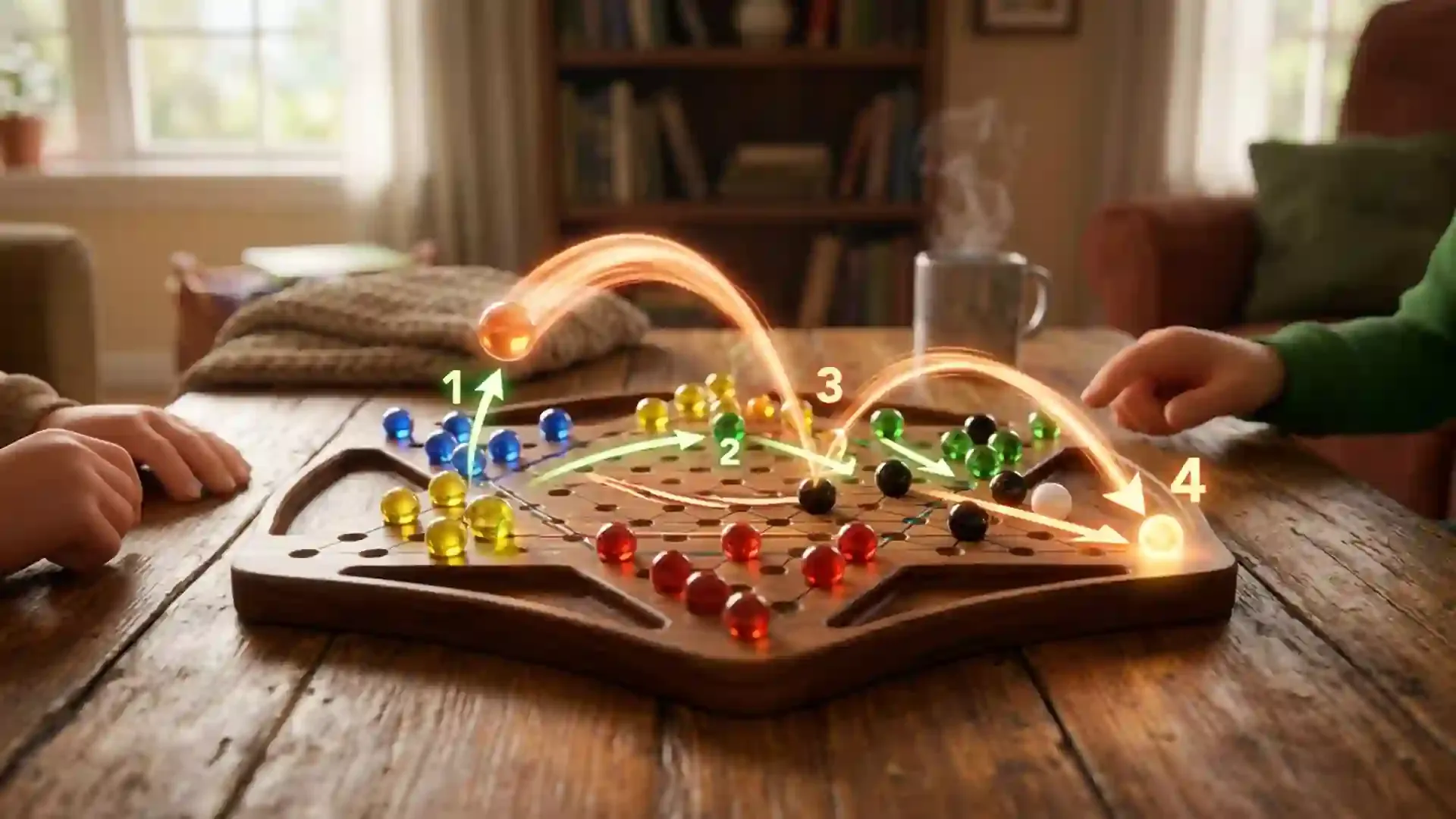
Chinese Checkers is an old and loved board game enjoyed by players of all ages for hundreds of years. The game may be called Chinese Checkers but it was created in Germany in the late 1800's.
Currently, many families play this popular game with their friends and family. This manual is created to give the reader a thorough guide on the setup for this game, learn the rules, winning the game, how to play other versions of Chinese checkers, and to answer common questions asked.
Also, if you love board games, once you learn how to play Chinese Checkers, you may want to continue playing checkers online by playing standard checkers on an 8x8 square board.
Table of contents
What Is Chinese Checkers?
In Chinese Checkers, players should range from two to six in number. To play this game, there is a board that is star-shaped, where the players start at the points of the board. Ten marbles are placed at the beginning by each player within the star triangle.
The objective of this game is to get the marbles belonging to the player to the triangle opposite his position. He can move the marbles by taking one marble at a time, or he can jump over the marbles and land in a vacant place. To win this game, it will take strategic planning and speed. If you already know how to play checkers, the biggest shift here is that there is no capturing of other colored marbles.
How to Set Up Chinese Checkers
The game of Chinese Checkers is easy to set up, depending on the number of people playing. If you already know how to setup a checkers board for the standard 8x8 game, this star-shaped version offers a unique twist.
Setting Up for 2 Players
For instance, if there are two people playing, they will sit on opposite sides and use opposite triangles as their starting point, using all their ten marbles inside the triangle.
Setting Up for 3 Players
If there are three players, then all will use every alternate triangle around the star-shaped board, ensuring equal spacing between everyone.
Setting Up for 4 Players
When four people are playing, they will use four alternate points of the star, leaving two empty spaces.
Setting Up for 6 Players
When there are six players, the game utilizes its maximum capacity. Everyone can pick a triangle to start from so that all points of the star are filled.
Who Goes First?
No matter the number of players, ten marbles will go into the starting triangle shape of your corresponding color. After you and the other players have selected their marbles and decided upon the starting point, you can determine who goes first with a dice throw, coin flip or agreement. Play then proceeds clockwise. Other diagonal-jump games follow a similar turn order, and players who enjoy this pre-game ritual often go on to play Brazilian Checkers online, where a comparable coin-flip or agreement decides who moves first.
How to Play Chinese Checkers: Core Rules Explained
The main objective in Chinese Checkers is to move all the marbles from one triangle to another, which lies at the other end of the star shape. In the game of Chinese Checkers, 60 marbles are used, each having a different color.
Equipment Needed to Play
To play Chinese Checkers, you need a traditional star-shaped board with 60 holes and a set of 60 marbles, each in a distinct color (10 per color).
How to Move — Steps and Hops
A marble may be moved to an adjacent empty space, or it may be leaped over any colored marble into an empty space immediately after it. The marble that is to be jumped over can be of any color.
Chain Hopping — Moving Multiple Spaces in One Turn
Jumping over several consecutive spaces can indeed make your game go faster. If after your first leap, you are able to leap again using the same marble, you can continually leap over pieces, but they can only be leaped over one at a time and onto an empty space. If you already know how to double jump in checkers, this chain mechanic will feel familiar.
What You Cannot Do — Illegal Moves
While jumping is the core mechanic, you cannot jump over more than one marble at once. Additionally, a marble cannot be placed on an occupied space. Lastly, you cannot move a marble into an opponent’s home triangle, except when it is your own finishing triangle.
A marble may be moved to an adjacent empty space, or it may be leaped over any colored marble into an empty space immediately after it. If you already know how to double jump in checkers, this chain mechanic will feel familiar. If after your first leap, you are able to leap again using the same colored marble, and if so, the marbles can be continually leaped over, but they can only be leaped over one at a time and onto an empty space.
Jumping over several consecutive spaces can indeed make your game go faster, but you cannot jump over more than one marble at once. The marble that is to be jumped over can be of any color, but cannot be positioned on top of an occupied space or in an opponent’s home triangle, except when it is his/her own finishing triangle.
Chinese Checkers Strategy: Tips to Win Every Game
Undoubtedly, Chinese Checkers is not a mere game of chance since it employs several different strategies to emerge victorious. Although there is no secret technique that shows you how to win checkers every time, it becomes very important to learn the art of board positioning in this star-shaped variant. A strategy that players usually apply is controlling the middle of the board since one’s pieces would be able to travel faster and further from the middle point.
Build a Bridge
Creating bridges where pieces of your color are aligned so you can chain the leaps is another well-used strategy in Chinese Checkers, helping you move pieces in large groups across the board. Moving large clusters of marbles forward will make for easy leapfrog movements to move ahead of opponents.
Best Opening Moves — Sidewinder and Cross Caterpillar
The strategy you use will also greatly depend on how you open the game. The Sidewinder involves moving the marbles along the edges to avoid traffic jams, whereas the Cross Caterpillar makes a linear path across the board.
How to Block Your Opponents
Blocking opponents is a very useful tactic. If an opponent is attempting to set up a chain of leaps across the board, then placing a marble in key spots will make it difficult to continue this pathway across the board and allow you to advance further than them. Try to keep your marbles close together; there is no way to chase down lost marbles that have been left far behind the rest.
Key strategy points:
- Control the center of the checkerboard.
- Make bridges and chain hops over the marbles.
- Opening moves like Sidewinder and Cross Caterpillar.
- Block opponents at critical points.
- Keep marbles moving forward as a group.
- Advance your pieces together to avoid leaving marbles behind.
Chinese Checkers Variations
Chinese Checkers has several variations that make the game a little more fun and challenging. Shifting your layout not only keeps the gameplay fresh but also amplifies the brain benefits of checkers variants by forcing your mind to adapt to new spatial patterns.
Super Chinese Checkers — Long Jumps
This is an example of a variation, Super Chinese Checkers, in which marbles can move many spaces, provided they move over just one marble per move. Another variation is teaming, in which you play with another person who helps you create a path for both of you. If you are aiming for quick games, you can use six marbles each instead of ten.
Conclusion
This guide has detailed how to set up Chinese Checkers, how to play the game, and ways that you can strategize how to win the game. Even if players love to argue whether is chess harder than checkers, the star-shaped version of the latter shows that this game also has its complexities. Just like any other game, the rules of Chinese Checkers can help you enjoy playing the game, which means that you can organize tournaments and play many games.
FAQs
- Chinese Checkers originated in Germany in 1892 and it was marketed as having a name of Chinese origin to attract buyers.
- The marbles must be able to be jumped, regardless of color, either their own or that of an opponent, but they cannot jump and land on other marbles.
- Indeed, marbles can be moved in all directions, that is, forward, backward, and even sideways on the board. Marbles are free to move in whichever direction is best for finding the shortest route towards the other triangle.
- Chinese Checkers and ordinary checkers differ in the way that, in Chinese Checkers, players begin from any of the 6 points found around the border with the help of 10 marbles having the same color, and winning means getting to the opposite side. However, in ordinary checkers, players can move their marbles forward only until they get to the other end.
- Super Chinese Checkers (or Fast-Paced Chinese Checkers/Tiaoqi) is another variation of the rules, where the movement of pieces differs substantially, resulting in a faster game.

Physical Board vs. Digital Checkers: Does the Classic Feel Get Lost Online?

US vs UK: Which Country Really Loves Checkers? (Checkers vs Draughts, Explained)

Enjoy Free Multiplayer Checkers with Friends Online
What Checkers Teaches You: Skills Beyond the Board
The Psychology of Checkers: Why This Simple Game Plays Mind Games