


How Many Pieces in Checkers? Counts, Setup & Variations

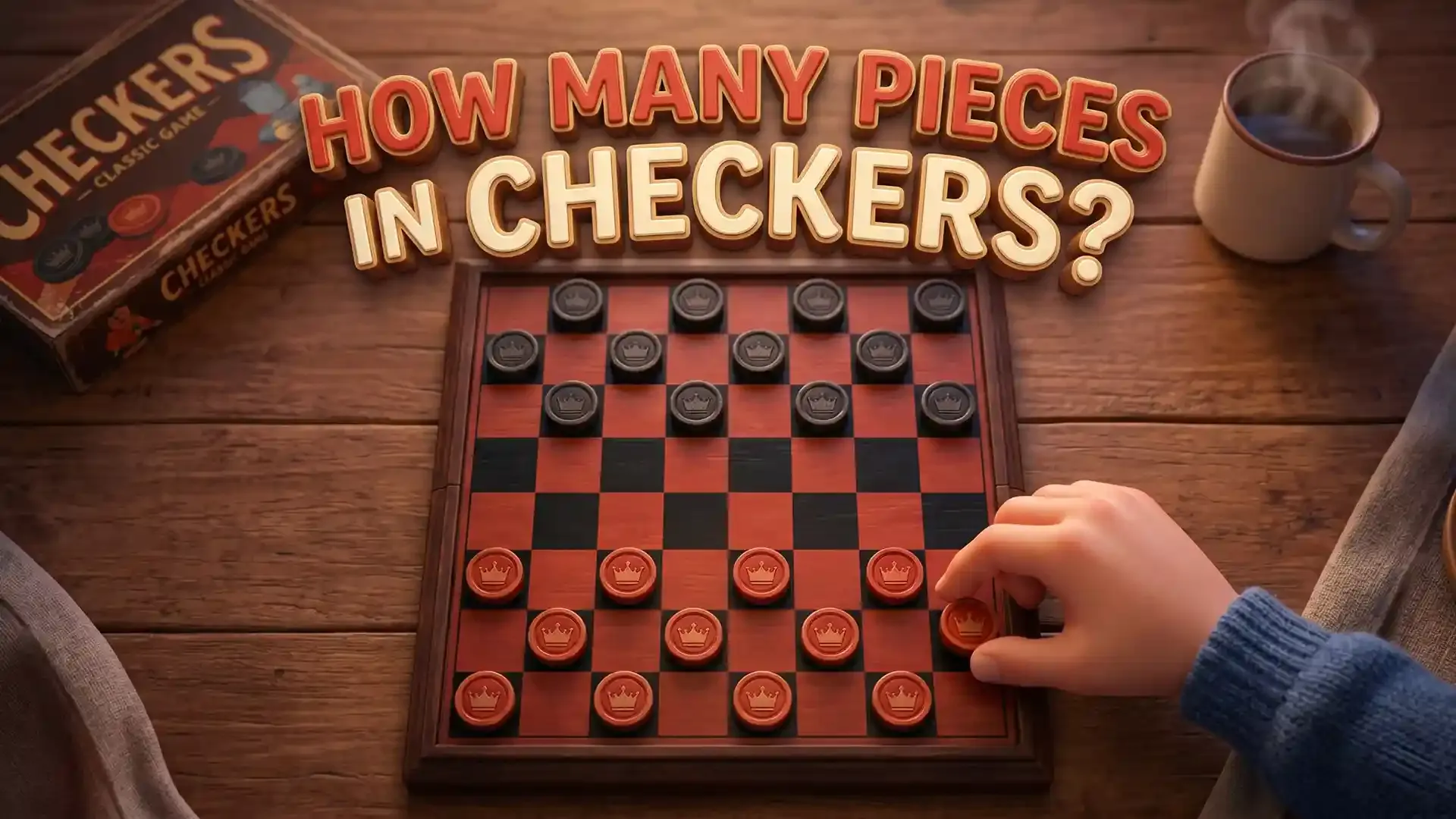
When you set up a game night or dust off a board from the closet, you might need to count the tiny plastic or wooden discs to make sure your checkers set is complete. The first step in setting up a fair match is knowing how many pieces in checkers there should be. Even one missing token messes up the game's balance on the board.
Playing checkers online is fantastic for sharpening your opening traps and testing moves against players worldwide. You can do this while learning the physical game dynamics, too. Standard piece counts and setup info are covered here, plus alternative formats for different international variants. So whether you're prepping for a local game or an online match, this guide's got you covered.
Table of contents
How Many Pieces in Standard Checkers Set?
Pop open a classic box of checkers and dump out the components. A complete standard checkers set contains 24 playing pieces. When you want to teach a newcomer how to play checkers for beginners, a retail board game will typically come with this exact count. Yet some makers slip in two additional disks, one light, one dark, just in case any go missing during play. These extras help keep the game whole, even after years of use.
How Many Pieces Does Each Player Get?
Each player starts with 12 pieces, identical to American Checkers, for a total of 24. Whether you are arranging a physical board or looking up checkers vs draughts online, the player on one side takes control of the darker set, often colored black. At the opposite end, the second participant uses lighter discs, commonly red or white. Game setup splits them evenly by shade before play begins.
Each side needs matching counts, so one person does not get a stronger setup by mistake. Before play begins, take a moment to confirm that both sides line up evenly.
What Do the Pieces Look Like?
Standard checkers pieces are simple, disk-shaped tokens. They are round, flat, and frequently engineered with ridges on the top and bottom. These ridges are not just decorative; they serve a practical purpose by locking the tokens together securely when a piece is promoted to a King during gameplay.
While exploring the history of checkers reveals that early game pieces were made from simple materials like baked clay or wood, modern plastic and wooden sets use this rigid design to prevent accidental mixing of components from other games. They are built specifically to stack seamlessly during the chaotic endgame phase.
How to Set Up Checkers Pieces on the Board
Correct piece positioning is paramount because checking your layout prevents illegal opening advantages. If you want to master the standard checkers board setup, you should understand that all 24 pieces are active at once and must be placed carefully. Use this method to arrange your board perfectly:
- Orient the Board: Position the board between both players so that the bottom-right corner closest to each person is a light-colored square. A classic way to remember this rule is the phrase: "Light on the right."
- Identify Active Spaces: All pieces are placed, moved, and captured exclusively on the 32 dark squares. The remaining 32 light squares must remain completely vacant throughout the match.
- Place Black's Army: The player commanding the black pieces places their 12 discs on the dark squares spanning the first three rows closest to their side.
- Place Red's Army: The player commanding the red pieces mirrors this layout, placing their 12 discs on the dark squares of the first three rows closest to their side.
- Verify the Middle Rows: Once setup is finished, the two central rows of the board should be entirely clear. This empty zone acts as the starting battlefield.
Board Layout Summary
| Attribute | Standard Configuration |
|---|---|
| Grid Size | 8x8 (64 total squares) |
| Active Play Spaces | 32 dark squares only |
| Total Game Pieces | 24 pieces |
| Pieces Per Player | 12 pieces |
| Starting Rows Occupied | 3 rows per side |
| Empty Center Rows | 2 rows |
What Happens to Pieces During the Game?
As the match progresses, the structural role and movement capabilities of your pieces will evolve based on their position on the board. This structural evolution directly influences how many game pieces in checkers you can successfully maintain on the board. Every trade matters, and every loss thins out your defensive lines. If too many pieces end up boxed in with no legal moves left, the game can even end in a stalemate in checkers rather than a clean capture-based finish.
Regular Pieces (Men)
At the start of the game, all 24 tokens are classified as regular pieces, historically referred to as "men." Under official Checkers Rules, regular pieces have strict movement limitations:
- They can only move diagonally forward toward the opponent's side.
- They can only advance one square at a time into an adjacent, vacant dark space.
- They can never move straight ahead, sideways, or backward, even if they are under immediate threat of capture.
Kings — How a Piece Gets Promoted
When a regular piece successfully navigates across the battlefield and lands on any dark square in the very last row of the opponent’s side (known as the "King Row"), it earns a promotion.
To represent this upgrade visually, you crown the piece by stacking a captured token of the same color directly on top of it. Mastering king moves in checkers means understanding that once crowned, a King gains significant tactical power. While it must still travel along the dark diagonals, one square at a time, it breaks the forward-only restriction and can move or capture in both directions.
How Many Pieces Are in Different Checkers Variations?
Though common in both the U.S. and the U.K., the 24-space setup shifts overseas - board sizes differ, so do piece numbers, reshaping totals used worldwide.
- On a 10x10 grid, International Draughts draws strong interest across Europe and select African regions. Twenty pieces go to each participant, occupying the first four ranks on each flank. That setup places forty checkers in play from the start. Movement spans diagonals, capturing by jumping when gaps allow behind opponent units.
- Thirty pieces stand ready on a sprawling 12-by-12 board when Canadian checkers begins. Instead of smaller grids, this version unfolds across wider terrain. From row one through five, every dark square hosts a piece per player. The layout spreads deep into the field, filling half a dozen lines with potential moves right from the start.
- Pieces enter play along the second and third lines of an ordinary checkerboard. Movement happens in straight directions - forward, backward, left, right - not across corners. Each participant controls sixteen units positioned at the outset behind vacant ranks. The bottom line remains free during setup. A typical eight-by-eight surface holds the entire arrangement. Motion differs sharply from common diagonal patterns seen elsewhere.
- Though called Chinese Checkers, it has no real link to China nor is it connected with checkers. A six-pointed star forms the playing surface instead of a square grid. Marbles move across holes set in the board, not flat pieces sliding on top. One person takes ten marbles at start, though some versions assign fifteen for quicker play. The shape spreads outward like rays, guiding movement from corner to opposite corner.
Checkers Pieces vs Chess Pieces — Quick Comparison
Though both games often share a single board, mixing up their parts is easy. However, a close look at Checkers vs Chess reveals deep contrasts, starting with how the pieces move and work. While both use an eight-by-eight grid, their logic is completely different.
In checkers, every piece looks and acts exactly the same at the start, moving strictly on the 32 dark squares. Chess uses all 64 squares, and each of the 16 pieces has a unique shape and distinct role. Furthermore, checkers pieces unlock backward movement by stacking together, whereas a chess pawn completely transforms into a different, more powerful piece upon reaching the end of the board.
Conclusion
Counting the checker pieces begins with knowing one full set includes 24. Twelve belong to each opponent, handed out evenly at start. Placing the game surface correctly means positioning it with black corners on both ends. The central rows stay vacant for movement space. Each player leaves their second and third lines free.
Before beginning, always verify each piece - whether online or at an event. With everything in place, play begins naturally. Only when the setup is complete does the game truly open up.
FAQs
- A standard checkers game features 24 pieces, split evenly into 12 dark (black) and 12 light (red or white).
- Most commercial retail sets include exactly 24 pieces. However, some premium or travel manufacturers include 26 pieces total to provide 2 extra spares in case a piece goes missing.
- Each competitor starts the match with exactly 12 pieces placed on the dark squares of the three rows closest to their side of the board.
- At the start of the match, unpromoted checkers pieces are technically called "men" or "regular checkers." Once a piece reaches the opposite baseline and gets stacked, it is called a "King."
- Twelve kings might sit on the board at the same time, though no rule sets a cap. Should every one of your original pieces reach the far edge, promotion turns each into a king, making that maximum possible. A full set promoted isn’t common, yet it remains within the game’s logic.
- Should all twelve of your pieces be captured by the opposing player, defeat is confirmed. Another way to lose arises when movement becomes impossible - despite having pieces left - if every single one stands trapped without a permitted move.

Physical Board vs. Digital Checkers: Does the Classic Feel Get Lost Online?

US vs UK: Which Country Really Loves Checkers? (Checkers vs Draughts, Explained)

Enjoy Free Multiplayer Checkers with Friends Online
What Checkers Teaches You: Skills Beyond the Board
The Psychology of Checkers: Why This Simple Game Plays Mind Games