


Checkers Rules: Complete Game Rules Explained Simply

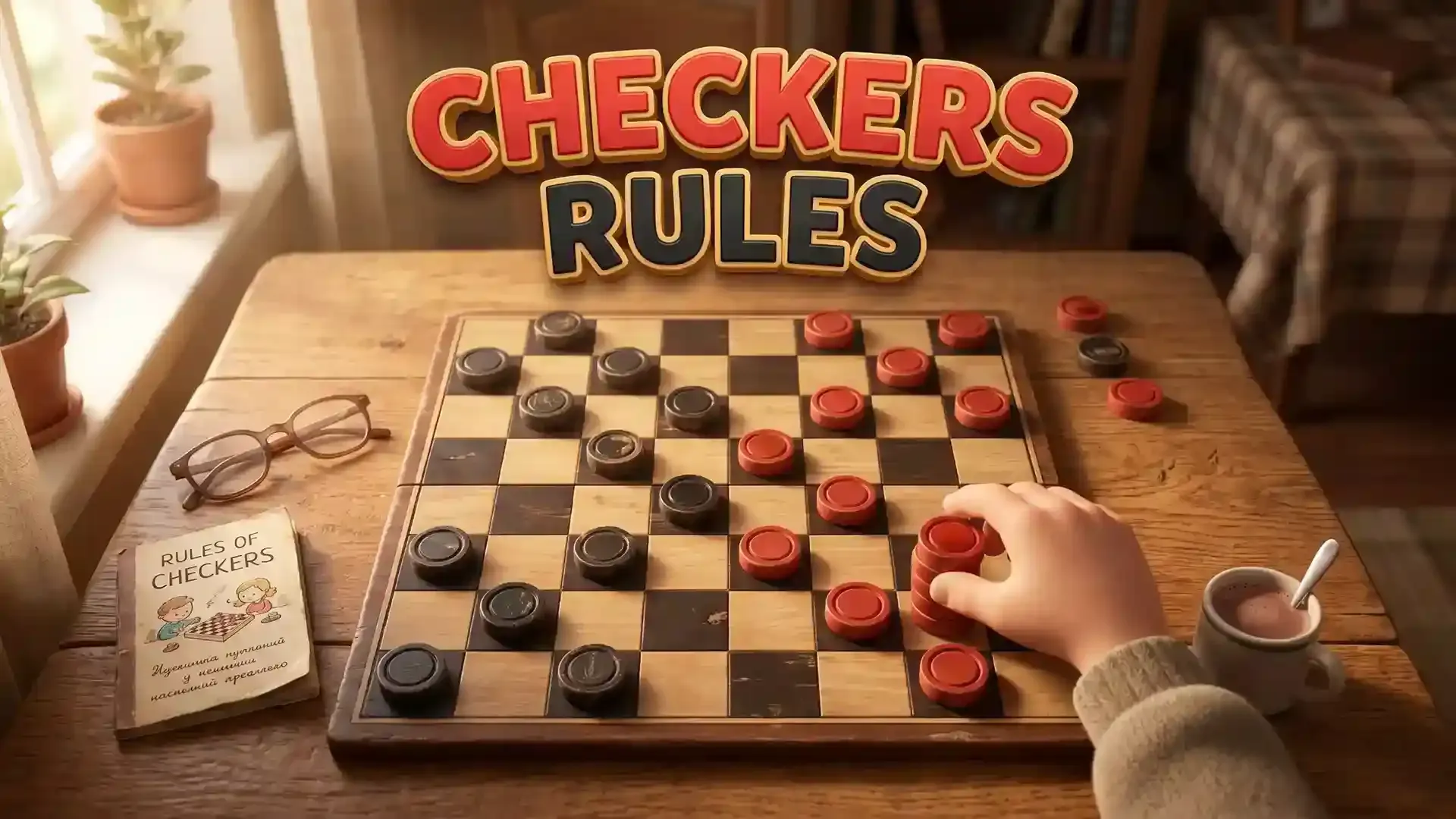
To master checkers, learn the rules in one place. Your goal is to either capture all of your opponent's pieces or block them so they can't make any more moves. Each game is a fast-paced battle that tests your strategy and planning. One mistake could tear down your defense.
Whether you practice at home or play checkers online, pieces move exclusively on the 32 dark squares. Pieces move diagonally, and pouncing forward is allowed, but only until the back row. If a piece gets there, it becomes a King. Then, it can trounce across the board, moving and jumping backward or forward. So, always aim to protect your pieces while trapping your opponent's.
Table of contents
Master the Basic Game Rules of Checkers

Before moving a single piece, establishing a flawless starting layout is essential. Correct piece positioning is paramount because checking your layout prevents illegal opening advantages. If you want to master the standard checkers board setup, you should understand that all 24 pieces are active at once and must be placed carefully.
The Checkers Board Setup
The game uses a standard 8x8 board with 64 alternating light and dark squares. To set it up correctly, remember these simple steps:
- Orient the Board: Place the board between the two players, ensuring the bottom-right corner is a light square for each player. An easy trick is "Light on the right."
- Identify Active Spaces: All pieces move, are placed, and captured only on the dark squares. So, there are 32 active spaces for gameplay. The remaining 32 light squares must remain completely vacant throughout the match.
How Many Pieces Each Player Gets
Each player gets 12 pieces, just like in American Checkers, for a total of 24. Whether you are arranging a physical board or preparing to look up checkers vs draughts online, the individual on one side takes control of the darker set, often colored black. At the opposite end, the second participant uses lighter discs, commonly red or white. Game setup splits them evenly by shade before play begins.
Each side needs matching counts, so one person does not get a stronger setup by mistake. Make sure to arrange both sides evenly on the first three rows before you begin. In official game rules checkers traditions, the player commanding the darker pieces (Black) always executes the first move of the match, after which players alternate turns.
Who Moves First In Checkers?
In official rules, the player commanding the dark-colored pieces always moves first. Depending on your board set, this means Black (or Red when paired with White or Light Oak) takes the opening turn. Because the first move advantage can influence tactical control of the center, casual players often decide who gets the darker pieces through a quick coin toss or by hiding a game piece in one hand for the opponent to guess.
The "Light-on-Right" Board Orientation Rule
Proper board alignment is essential before placing your pieces. Every player must orient the board so that a light square sits in the bottom-right corner closest to them. A quick way to remember this universal setup rule is "light on the right." Even though a standard grid features 64 total spaces, correct orientation ensures all 24 pieces align properly across the 32 dark squares used for active gameplay.
Numbered Board Notation (1 to 32)
To record moves and study strategies, players use standard board notation. Official tournaments number only the 32 dark gameplay squares from 1 to 32, counting left to right starting from Black's home row down to White's side. Squares 1 through 4 sit on Black's back row, while 29 through 32 form White's base. Moves are written by listing the starting and landing squares separated by a hyphen, such as 11-15 for a classic opening step.
Foundational Rules for Checkers Movement

As the match progresses, the structural role and movement capabilities of your pieces will evolve based on their position on the board. This structural evolution directly influences how many tokens you can successfully maintain on the field. Every trade matters, and every loss thins out your defensive lines.
Standard Checkers Game Rules for Moving
At the start of the game, all 24 pieces are just regular men, as they've been called for ages. When you're learning how to play checkers, remember the basic rules for these standard pieces.
- Regular pieces move diagonally forward towards the opponent's side.
- They can only advance one square at a time and land in an empty, dark spot.
- Also, no moving straight ahead, sideways, or back, not even if it means dodging an impending capture.
Which Squares Can Pieces Move To?
Because regular pieces are restricted to diagonal paths, they are permanently locked onto the 32 dark squares. A piece can never step onto a light square under any circumstances. If an adjacent diagonal dark square in front of your piece is occupied by your own team, that path is blocked. If it is occupied by an opponent, it sets up a potential capture opportunity.
Checkers Jumping Rules Explained

Capturing your opponent's tokens is the primary mechanism for thinning their lines and clearing a path to victory. This is governed by strict, non-negotiable checkers jumping rules that form the tactical core of the game.
How to Jump an Opponent's Piece
When an opponent's piece sits on a diagonal square directly in front of yours, and the dark square immediately behind it is completely vacant, you are eligible to execute a jump. Your piece leaps over the enemy token and lands in that open space. The jumped piece is immediately removed from the board and collected as a capture.
The Multi-Jump Rule
The tactical depth spikes significantly with the multi-jump rule. When you land on a square allowing you to leap over an opponent right away, you must do it that turn. Pieces can jump multiple times, forming a zigzag pattern and taking out many on the other side at once. You can even connect jumps to knock out groups of pieces, which is really cool. So, you might chain two, three, or even more jumps together, sweeping away big bunches of your opponent's pieces.
Is Jumping Mandatory?
One of the most defining aspects of the rules for checkers is the mandatory capture rule. If a jumping opportunity is available anywhere on the board on your turn, you must take it. You cannot choose a standard, passive positional move instead.
- Historical Note: In older eras, a custom called "huffing" allowed a player to confiscate their opponent's piece if that opponent failed to notice a mandatory jump. Under modern official rules in the checkers game, huffing is obsolete. If you miss a mandatory jump, your opponent simply points it out, the illegal passive move is undone, and you are required to execute the capture.
Can You Jump Your Own Pieces or Jump Two Pieces in One Leap?
Two common beginner misconceptions violate standard checkers rules:
- Friendly Jumping: Strictly illegal. You can only jump over opponent pieces to capture them, never your own.
- Double-Leap Single Hops: You cannot jump two adjacent enemy checkers in one leap. Every jump requires a vacant landing square directly behind the enemy piece. Multi-jumps must happen step-by-step, landing on an open dark square after every single capture.
Checkers King Rules
Reaching the opposite edge of the board completely rewrites your strategic capabilities, turning a restricted foot soldier into a dominant tactical weapon.
How a Piece Becomes a King
In chess, when a pawn reaches any square on the last row of the opposing side, it gets promoted. The piece is then crowned to show this upgrade. You do this by placing a stacked captured token of the same color on top of it. So, it's like the pawn becomes a brand new piece right there.
Standard checker pieces are simple, disk-shaped tokens. They are round, flat, and frequently engineered with ridges on the top and bottom. These ridges serve a practical purpose by locking the tokens together securely when a piece is promoted to a King during gameplay.
While exploring the history of checkers reveals that early game pieces were made from simple materials like baked clay or wood, modern plastic and wooden sets use this rigid design to prevent accidental mixing of components from other games. They are built specifically to stack seamlessly during the chaotic endgame phase.
How Kings Move Differently
Mastering checkers king rules means understanding that once crowned, a King gains significant tactical power. While it must still travel along the dark diagonals, one square at a time, it breaks the forward-only restriction and can move or capture in both directions.
This multi-directional movement makes Kings incredibly efficient at hunting down escaping enemy pieces or defending vulnerabilities in your own territory.
Kinging During a Multi-Jump Sequence
Reaching the opponent's back row during a multi-jump sequence triggers a specific edge-case rule in American Checkers. If an uncrowned piece lands on the crown row mid-jump, it receives an immediate promotion, and its turn ends on the spot. Even if additional backward jump opportunities open up, the piece cannot execute them in that same turn. It must stop, receive its crown, and wait for the next turn to unleash its new abilities as a King.
How to Win a Game of Checkers
A match concludes definitively under two specific scenarios dictated by the rules of the game of checkers.
Winning by Total Capture
The most frequent path to victory is wiping out the opposition. When you successfully capture all 12 of your opponent's pieces, leaving them with zero tokens on the board, you win the game.
Winning by Blocking (The Stalemate Rule)
A common point of confusion for beginners transitioning between Checkers vs Chess involves stalemates. In chess, trapping a king with no legal moves results in a draw. However, checkers enforces a strict rule of elimination by entrapment. If you successfully surround your opponent's remaining pieces so that it is their turn to play, but they do not possess a single legal diagonal move, you win the game instantly.
Declaring a Draw & Insufficient Material
There is another part that every beginner needs to learn and understand: declaring a draw, or learning how to tie, is another rule and skill set to understand in checkers.
How To Draw in Checkers
A match ends in a draw when neither player can force a victory, which typically occurs through mutual agreement when the board reaches a deadlock. Ties also happen due to insufficient material, such as a single King against another single King where an endgame win is mathematically impossible, or under the 3-fold repetition rule, where the exact same board position occurs three times in a row.
Checkers Tie Rules
Under standard checkers tie rules, a game can end in a tied match through a few official scenarios rather than a victory. The most common is an agreed draw, where both players recognize a complete deadlock and mutually accept a tie.
A draw also happens due to insufficient materials, such as a 1 King vs 1 King endgame where neither side has enough piece strength to force for a win. At the end, the kings' positions keep repeating, which automatically makes the game a tie, but you should know how to draw in checkers, as it also helps you save points when you are in a position where you can’t win.
Beginner Strategy Tips to Win More Games
Mastering basic checkers strategy for beginners comes down to space and trades. Use these three core tactics to build a positional advantage and learn how to win checkers:
- Center Control: Always first try to have command in the center because from there you can dictate the game and also can put a limit on opposition diagonal moves.
- Back Row Anchor: Never let an opposition piece come very near to your own side of the row so it will not gain king promotion.
- Strategic Exchanges: Use 1-for-1 piece exchanges when you lead to simplify the board and force a quick endgame win.
Rules of Checkers Variations

American Checkers, or English Draughts, is super popular, but the World Draughts Federation also recognizes other versions. These change up the board size, piece count, and how things move around.
- International Draughts: The most popular variant out there. Played on a bigger 10x10 board with twenty pieces per player, it rocks the "Flying Kings" rule; kings zip along any number of empty diagonal spaces like a chess bishop. Regular pieces also get to hop back and capture in any direction. Plus, players must follow the majority-capture rule: they need to pick the hop sequence that captures the most pieces.
- Russian Draughts (Shashki): Takes place on an 8x8 board with twelve pieces a side. The cool thing here is it uses the "Flying Kings" rule too - kings jump back after hitting the far row on their very same turn.
- Brazilian Draughts: For this game, think of 10x10 International Draughts' rules stuffed onto an 8x8 board, starting with 12 pieces on each side. That means Flying Kings plus other capture twists in a smaller arena.
- Turkish Draughts (Dama): It is unique because its pieces don't slide diagonally at all! On an 8x8 grid with 16 starting pieces a side, they move left, right, or forward one spot at a time, kicking off from the second and third rows. Jumps happen straight ahead or sideways. When you get a King piece, it can zip across any open spaces on straight horizontal lines.
Quick-Reference Rules Table
| Rule Element | American Checkers / English Draughts | International Draughts | Russian / Brazilian Draughts |
|---|---|---|---|
| Grid Dimensions | 8x8 (64 squares) | 10x10 (100 squares) | 8x8 (64 squares) |
| Starting Pieces | 24 (12 per player) | 40 (20 per player) | 24 (12 per player) |
| Active Tiles | 32 Dark Squares | 50 Dark Squares | 32 Dark Squares |
| Jumping Direction | Forward only for regular pieces | Forward and Backward for all | Forward and Backward for all |
| King Abilities | Moves 1 square forward/backward | "Flying King" (multi-square slide) | "Flying King" (multi-square slide) |
| Capture Choice | Any valid jump sequence | Must choose the majority capture | Any valid jump sequence |
Conclusion
Getting the basic rules of checkers changes how you play. Mastering moves diagonally, the must-capture rule, and turning pieces into kings at the end gives you real depth. It transforms the game from just a casual thing to something that needs smart planning ahead. To start, put the light square on the right, get your board ready, and use those classic strategies to see how they work for you.
FAQs
- Official rules require a match to be played on the dark squares of an 8x8 board with 12 pieces per side. Black moves first, jumps are mandatory, and trapped players lose.
- Yes. A King can execute a multi-jump sequence tracking both forward and backward across the dark diagonals, provided each jumped piece has an open, vacant landing pad directly behind it.
- Regular pieces (men) can never move or jump backward. Only when a piece reaches the final row and upgrades into a King does it unlock the ability to move and jump backward.
- Yes. Under standard rules, jumping is completely mandatory. If a capture line opens up on the board, you must execute it instead of taking a normal positional step.
- If it is your turn and you have no legal moves because your remaining pieces are blocked, you lose the match. Checkers does not feature a draw via stalemate.
- Yes, an uncrowned checker can jump and capture an enemy King. Any standard piece can execute the capture by moving diagonally forward, provided there is a vacant landing square directly behind the enemy King.

Physical Board vs. Digital Checkers: Does the Classic Feel Get Lost Online?

US vs UK: Which Country Really Loves Checkers? (Checkers vs Draughts, Explained)

Enjoy Free Multiplayer Checkers with Friends Online
What Checkers Teaches You: Skills Beyond the Board
The Psychology of Checkers: Why This Simple Game Plays Mind Games